

pro $24.99 per month
- access to all Manning books, MEAPs, liveVideos, liveProjects, and audiobooks!
- choose one free eBook per month to keep
- exclusive 50% discount on all purchases
- renews monthly, pause or cancel renewal anytime
lite $19.99 per month
- access to all Manning books, including MEAPs!
team
5, 10 or 20 seats+ for your team - learn more
Look inside
"A practical guide for anyone who wants to move beyond demos and create agentic systems with confidence.”
—Elliot Kim, Coupang Inc.
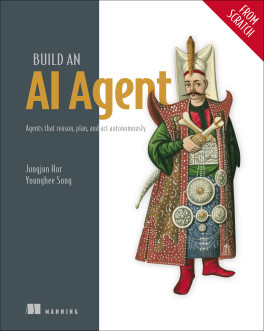
Build an AI Agent (From Scratch) is a fascinating step-by-step journey through design, development, and deployment of a system of autonomous AI agents. Authors Jungjun Hur and Younghee Song guide you concept by concept as you build a sophisticated research agent in Python, designed to solve complex, multi-step tasks from the rigorous GAIA (General AI Assistants) benchmark. By seeing the construction of the system end to end, you’ll understand how the underlying mechanics are unobstructed by any existing blackbox libraries and frameworks.
This book includes ten meaty chapters and a handy appendix (about how to get an OpenAI API key). The technical explanations throughout the book are made crystal clear by the use of many helpful diagrams. As one reviewer remarked, even for someone building their first agent, “nothing feels like magic or a mystery after the first few chapters!”
Early on, you’ll establish the foundational blueprint for your agent by distinguishing rigid developer-defined workflows from true, LLM-directed agent loops. You’ll learn how to manage stateless APIs, enforce structured outputs using Pydantic, and implement dynamic tool-calling. Crucially, the book centers on “Context Engineering”—the discipline of systematically structuring information to prevent context rot and the “Lost in the Middle” effect. One technical reviewer particularly appreciated that core concepts like agent loops, context engineering, and evaluation are introduced with clear motivation and practical examples rather than as isolated abstractions.
After you build the basic agent, you’ll progressively expand its capabilities by integrating custom web search, local file system exploration, and vector-based RAG to navigate complex data. You’ll also enable the agent to recall past failures and adapt state persistence through hierarchical context optimization and longterm memory. Along the way, you’ll see how to use the Model Context Protocol (MCP) to seamlessly connect your agent to external tools and servers.
Later chapters push into advanced territory. To prevent the agent from hallucinating or looping during complex tasks, you’ll implement explicit planning and procedural reflection. Then, you’ll explore the Code-Act paradigm, empowering the agent with sandboxed cloud environments to securely write scripts, run CLI commands, and compose tools dynamically. Finally, you’ll up-scale your project from a single agent into a collaborative, multi-agent architecture using the A2A protocol, where specialized tasks are routed to isolated sub-agents to maximize token efficiency.
Because highly autonomous agents carry real-world risks, the book culminates in a rigorous observability and evaluation pipeline. You’ll implement an automated LLM-as-a-judge system—powered by Open Telemetry—to trace, grade, and continuously refine the agent’s trajectory and outputs. By building every layer from the ground up, the book ensures that readers are left with a deep, practical understanding of AI mechanics.
what's inside
- End-to-end construction of a framework-free, autonomous AI agent in Python
- Advanced practical integrations including MCP, vector-based RAG, long-term memory, and sandboxed code execution
- Multi-agent orchestration and automated LLM-as-a-judge evaluation pipelines
about the reader
For Python developers with some knowledge of machine learning who want to build and deeply understand agentic systems without relying on abstract libraries.about the authors
Jungjun Hur is an independent AI and data engineer who specializes in building agentic systems for e-commerce. He is the author of Practical AI Application Development Using LLMs. Younghee Song is an AI consultant at PricewaterhouseCoopers (PwC). Both authors live and work in South Korea.concepts explained in this book
- Tool use is the capability of an AI system or agent to request external software operations through defined interfaces to obtain information or perform actions.
- A tool description is information specifying a callable tool’s purpose and how an agent or system can invoke it, including its inputs or parameters.
- Code execution is the process by which a computing system runs program instructions to produce results or effects.
- A rubric is a structured set of explicit criteria and guidance for judging the quality of an output, artifact, or behavior.
- Context engineering is the deliberate selection, organization, and management of information supplied to an AI system to support effective task performance.
- An AI agent is a computational system that uses artificial intelligence to interpret information and select or perform actions toward goals while interacting with an environment.
- Planning is the process of determining and organizing intended actions or steps toward a goal, often accounting for conditions or constraints.
- Structured data is information organized according to a defined schema or arrangement that makes its elements and relationships consistently interpretable and processable.
Delivers the essence of agent behavior instead of temporary usage techniques.
Gives you X-ray vision into the anatomy of autonomous agents, so the tools you use every day stop being black boxes.
Structured progression from fundamentals to advanced topics makes the book a strong long-term reference.
An absolute gold. The essential book for the agentic AI era.
Clear, well structured, and hands-on.
related titles
related titles
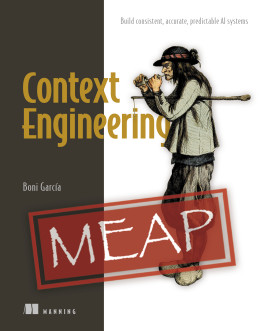
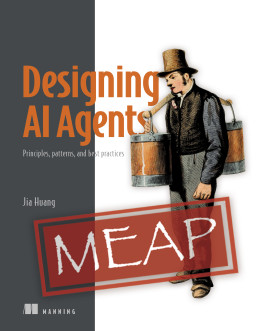
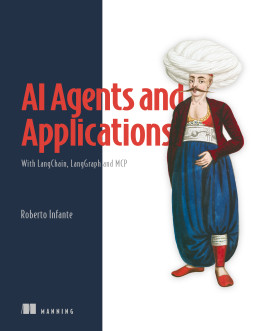


choose your plan
pro
monthly
annual
$24.99
$249.99
only $20.83 per month
- access to all Manning books, MEAPs, liveVideos, liveProjects, and audiobooks!
- choose another free product every time you renew
- choose twelve free products per year
- exclusive 50% discount on all purchases
- renews monthly, pause or cancel renewal anytime
- renews annually, pause or cancel renewal anytime
-
![Build an AI Agent (From Scratch)]() Build an AI Agent (From Scratch) ebook for free
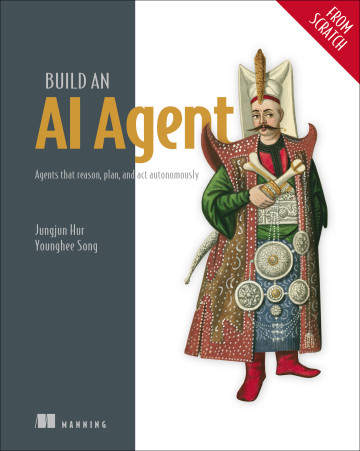 Build an AI Agent (From Scratch) ebook for free
team
monthly
annual
$49.99
$499.99
only $41.67 per month
- five seats for your team
- access to all Manning books, MEAPs, liveVideos, liveProjects, and audiobooks!
- choose another free product every time you renew
- choose twelve free products per year
- exclusive 50% discount on all purchases
- renews monthly, pause or cancel renewal anytime
- renews annually, pause or cancel renewal anytime
-
![Build an AI Agent (From Scratch)]() Build an AI Agent (From Scratch) ebook for free
choose your plan
pro
monthly
annual
$24.99
$249.99
only $20.83 per month
- access to all Manning books, MEAPs, liveVideos, liveProjects, and audiobooks!
- choose another free product every time you renew
- choose twelve free products per year
- exclusive 50% discount on all purchases
- renews monthly, pause or cancel renewal anytime
- renews annually, pause or cancel renewal anytime
-
![Build an AI Agent (From Scratch)]() Build an AI Agent (From Scratch) ebook for free
team
monthly
annual
$49.99
$499.99
only $41.67 per month
- five seats for your team
- access to all Manning books, MEAPs, liveVideos, liveProjects, and audiobooks!
- choose another free product every time you renew
- choose twelve free products per year
- exclusive 50% discount on all purchases
- renews monthly, pause or cancel renewal anytime
- renews annually, pause or cancel renewal anytime
-
![Build an AI Agent (From Scratch)]() Build an AI Agent (From Scratch) ebook for free
