1 Real-world Decision Making with Reinforcement Learning
Reinforcement learning is presented as a practical way to make better business decisions in uncertain, changing environments. The chapter opens by emphasizing that businesses operate with limited resources and must continuously decide how to respond to uncertainty, competition, and shifting conditions. It frames strong decision-making as a repeated, long-term process rather than a one-time choice, and introduces reinforcement learning as a method for learning what actions lead to better outcomes over time.
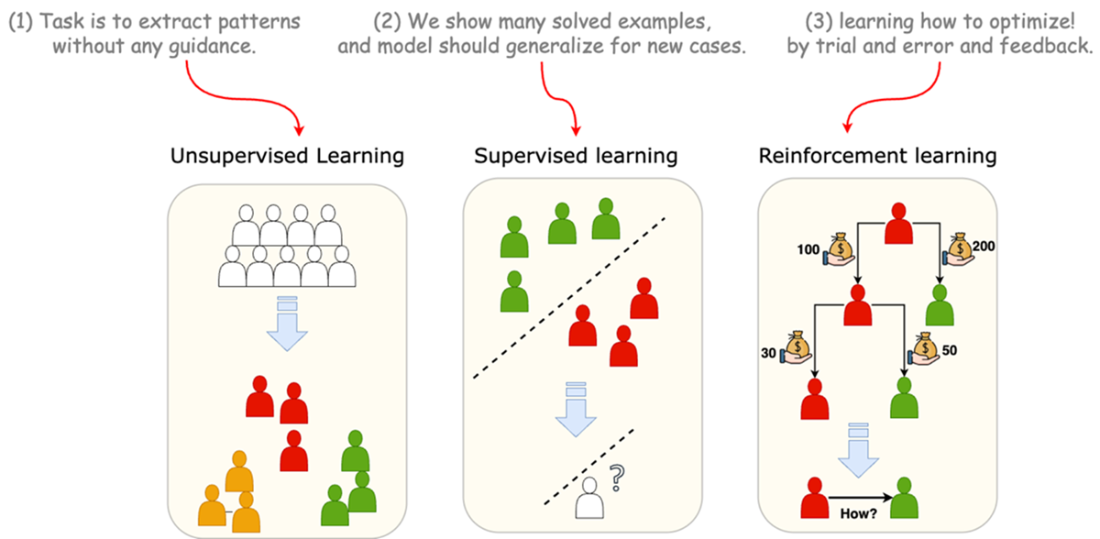
The chapter then distinguishes reinforcement learning from other forms of machine learning and business analysis. Supervised learning predicts outcomes from labeled examples, unsupervised learning finds patterns without explicit rewards, and reinforcement learning learns how to act by receiving feedback from actions taken in an environment. It also separates business questions into descriptive, predictive, explanatory, and optimization types, showing that optimization is especially relevant for operational, recurring, and quantifiable decisions such as inventory replenishment, routing, scheduling, rebalancing, and dynamic pricing.
Finally, the chapter surveys classical approaches like operations research, stochastic simulation, system dynamics, and game theory, explaining both their strengths and their limitations. These methods are useful, but they often depend on fixed assumptions, static models, or heavy human intervention when conditions change. Reinforcement learning is positioned as a complementary approach that can adapt through experience, handle sequential decisions, and improve policies over time. At the same time, the chapter is realistic about its drawbacks: it may require large amounts of data or simulation, can be computationally expensive, and may be harder to interpret than classical models.
Reinforcement learning in the context of machine learning.
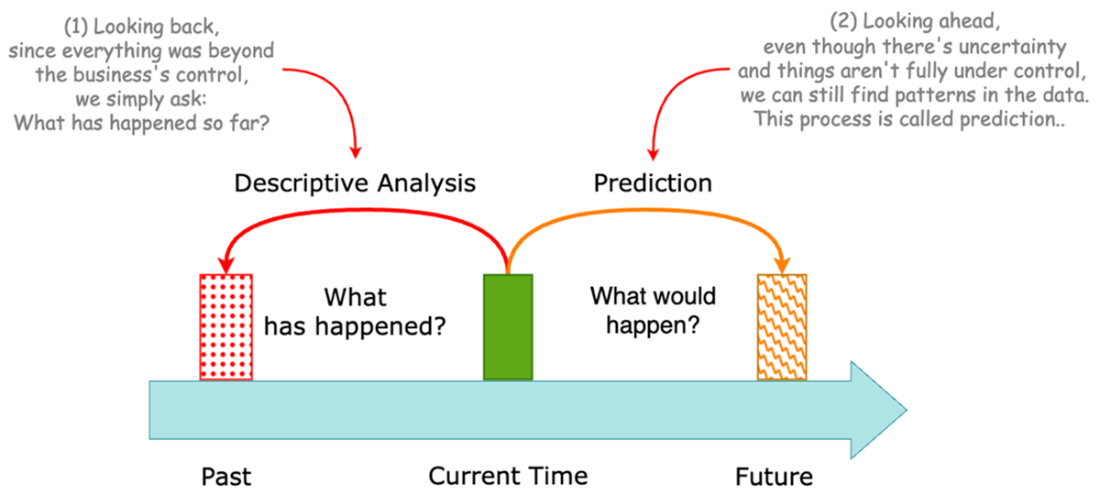
two types of questions and analytical approaches for analyzing external factors.
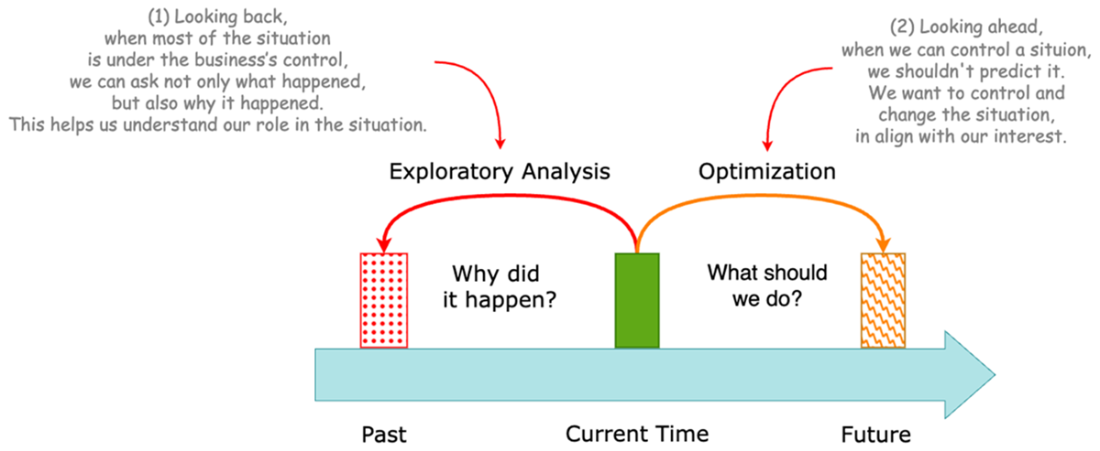
two types of questions and analytical approaches for analyzing internal factors.
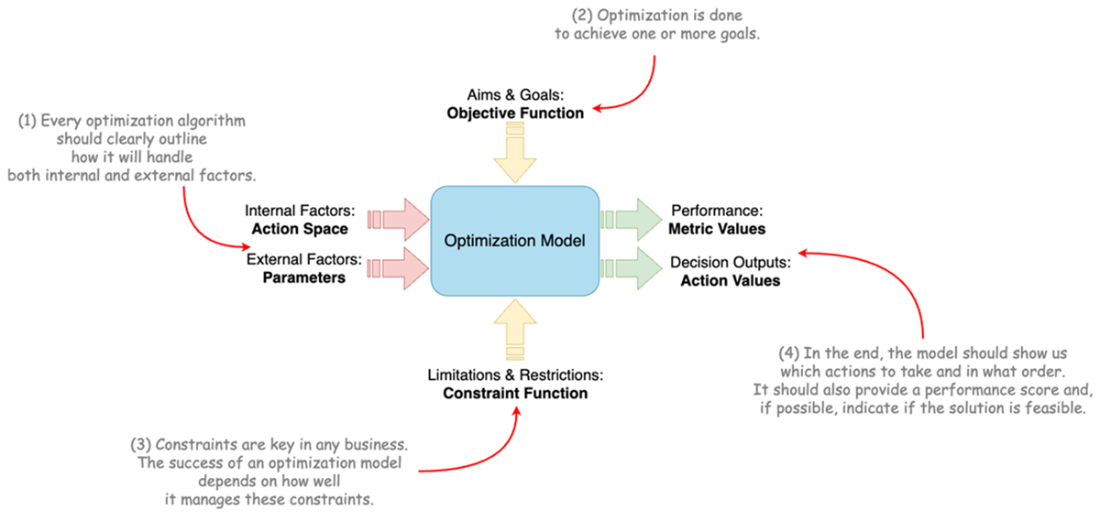
Framework for business optimization models.
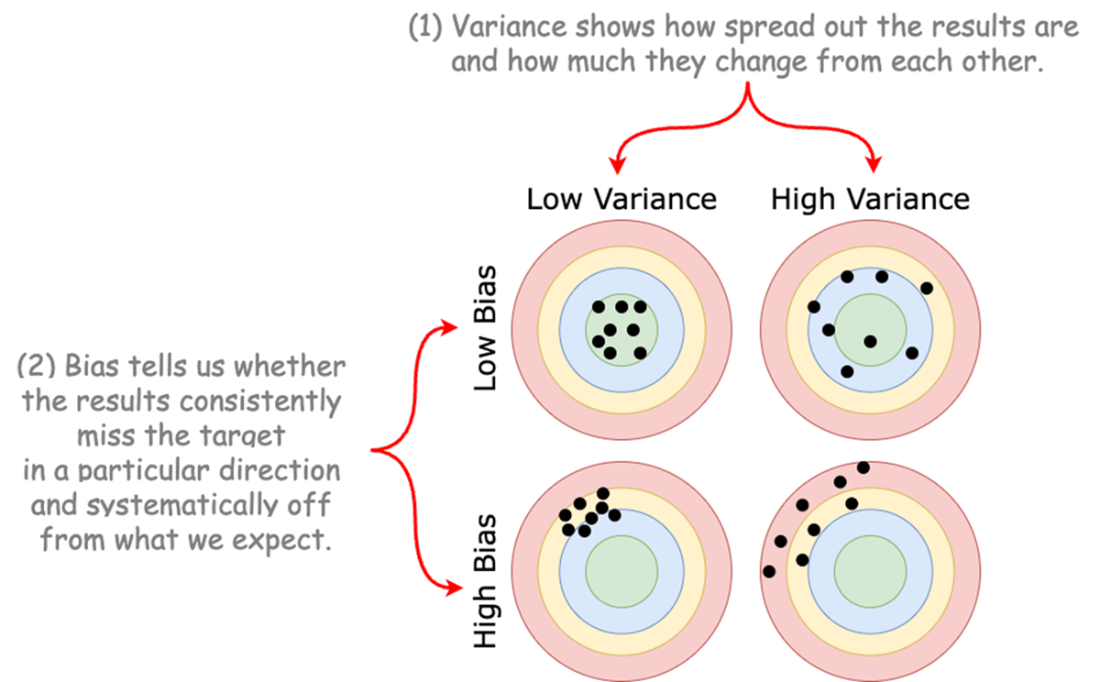
Variance and bias trade off in business optimization models.
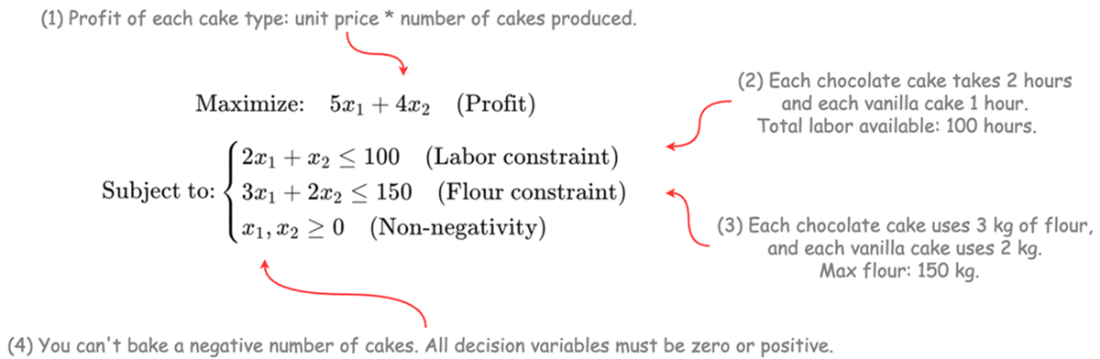
Linear programming formulation of bakery shop problem.
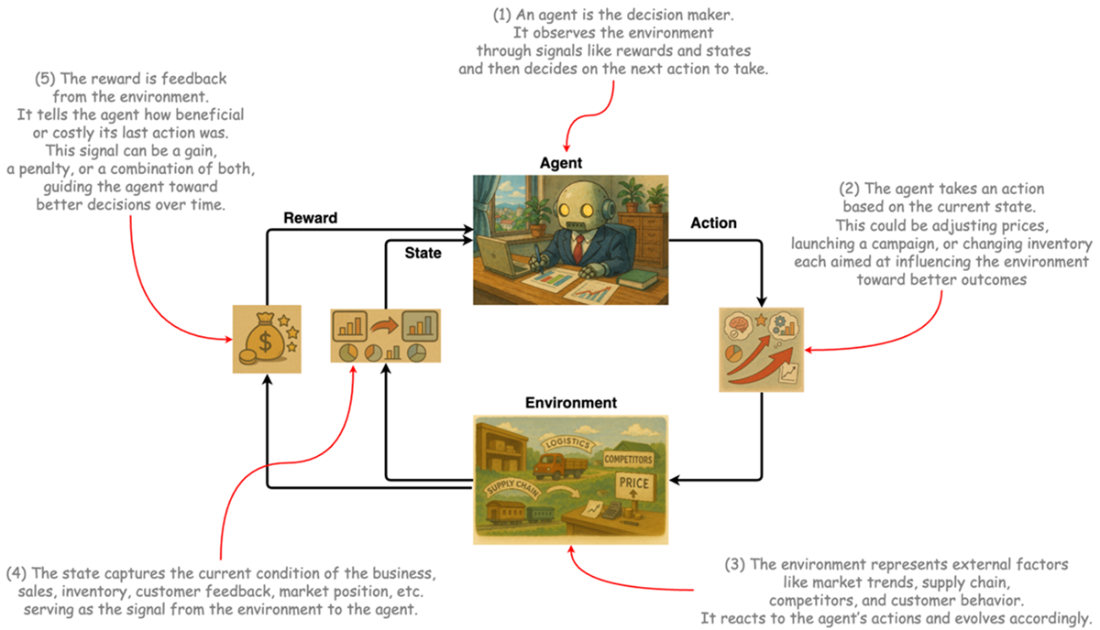
Overview of reinforcement learning framework.
Summary
Businesses must make smart decisions under uncertainty with limited resources.
Understanding external (uncontrollable) and internal (controllable) factors is key to effective analysis.
Business analysis types include descriptive, predictive, explanatory, and optimization.
Optimization focuses on shaping internal factors to improve future outcomes.
Decisions in business problems vary by level (strategic/tactical/operational), frequency, scale, and measurability.
Optimization models include inputs (parameters and decisions), objectives, constraints, objective outputs, and decision values.
Major challenge in optimization is bias-variance trade-offs in the operational process
Classical models like operations research, simulation, and system dynamics are powerful but often rigid and static.
Reinforcement learning extends classical models by enabling adaptive, sequential decision-making.
Reinforcement learning learns through trial-and-error, using feedback to improve policies over time.
A comparison shows reinforcement learning excels in adaptability, real-time learning, and dynamic environments.
Reinforcement learning downsides include training cost, data needs, and explainability—but it's improving rapidly.
Reinforcement learning is not a replacement but a powerful extension and complement of classical optimization models.
FAQ
What is reinforcement learning in the context of business optimization?Reinforcement learning is a framework for teaching systems to make decisions over time by interacting with an environment, receiving feedback, and improving through trial and error. In business optimization, it is used to learn sequences of actions that maximize long-term value under uncertainty.How is reinforcement learning different from supervised and unsupervised learning?Unsupervised learning finds patterns in data without labels or rewards, supervised learning learns from labeled input-output examples, and reinforcement learning learns how to act by receiving rewards or penalties from its actions. RL focuses on decision-making and long-term outcomes rather than only prediction or pattern discovery.What kinds of business questions are best suited for reinforcement learning?Reinforcement learning is best suited for sequential decision problems where actions affect future outcomes, especially when the environment is uncertain and changing. Examples include pricing, inventory replenishment, routing, scheduling, and customer engagement optimization.What is a business optimization problem?A business optimization problem is one where the goal is to choose the best actions under given constraints to improve an objective such as cost, profit, service level, or efficiency. These problems usually involve inputs, decision variables, constraints, and measurable outputs.What are examples of real-world business optimization problems?Common examples include inventory replenishment, vehicle routing, production scheduling, workforce shift planning, bike-sharing rebalancing, and dynamic pricing. These problems are usually recurring, operational, measurable, and involve multiple decisions.Why are classical optimization models sometimes limited in real-world business settings?Classical models often assume the system is fully known in advance and remains relatively stable. In reality, business environments change, uncertainty is high, and exact rules or inputs may be hard to define, which makes classical models less effective in dynamic settings.What are the main challenges in business optimization models?Key challenges include robustness, resilience, real-time responsiveness, adaptability, flexibility, generalizability, customizability, effort to build, effort to operationalize, lifecycle cost, and interpretability. A good model must perform well in messy, changing real-world conditions.How does reinforcement learning help overcome the limitations of classical models?Reinforcement learning learns from interaction rather than relying entirely on a fixed model of the world. This makes it more adaptable to changing conditions, better suited for sequential decision-making, and capable of improving policies over time as it gains experience.What are the core components of a business optimization model?A typical business optimization model includes external factors as inputs, decision variables or actions, an objective function to optimize, constraints that reflect real-world limitations, and outputs that report the chosen decisions and resulting performance metrics.When should a business consider using reinforcement learning instead of traditional methods?A business should consider reinforcement learning when decisions are sequential, outcomes depend on past actions, the environment is dynamic, and the company needs an adaptive strategy rather than a one-time static solution. It is especially useful when long-term optimization matters more than immediate one-step decisions.
pro $24.99 per month
access to all Manning books, MEAPs, liveVideos, liveProjects, and audiobooks!

 Applied Reinforcement Learning ebook for free
